October 11, 2026 · 10 min read
Our five-year Texas plan: an office and our own compute hall
We plan an office and a small liquid-cooled compute hall in Central Texas by 2031. The site, power, water, costs, gates and risks, with sources.
By the AdvisorPPC Team · Reviewed by Claude
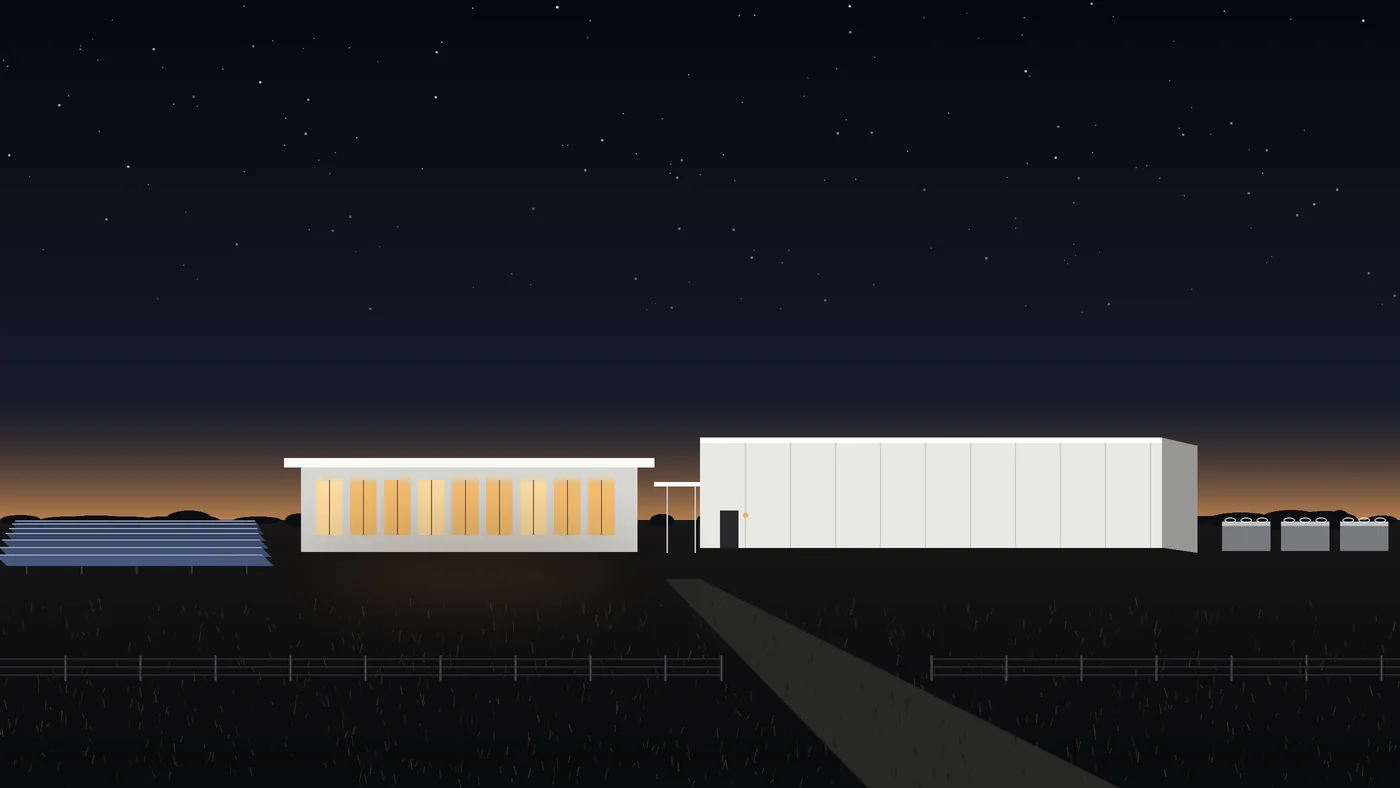
We are a small company that rents almost all of its computing. Over the next five years we plan to change that: an office in Central Texas, and beside it a small liquid-cooled compute hall that we own. This post is the plan, with the numbers we used and where each one came from. Nothing in it is bought, leased, permitted or applied for yet, and we have no office, land or registration in Texas today. We are publishing it early so that customers and neighbors can see what we intend and watch whether we do it. It is a plan, not a promise: it will change, and parts of it may not happen.
AdvisorPPC is a product of Advisor Media Group LLC, a Wyoming company. That company makes this plan and would own the site.
What are we planning?
Five planned steps. The intent is that each pays for itself before the next begins.
- Year 1: a leased office in the Taylor and Hutto area with a small GPU pilot in the room, 8 to 16 GPUs, and a search for land.
- Year 2: our first rack-scale NVIDIA system, hosted in someone else's liquid-cooled data center, and an option to buy land.
- Year 3: buy 20 to 40 acres, get utility service agreed in writing, permit and start building.
- Year 4: open the office and a pilot hall with 1 to 2 megawatts of computing load.
- Year 5: grow toward 5 megawatts if the work already running there justifies it.
The site is planned to stay far below 75 megawatts, the demand threshold that Texas Senate Bill 6 sets for its large-load rules.
Why Central Texas?
The country east of Austin is becoming a hardware corridor. Samsung is building a chip fab in Taylor as part of more than $37 billion of planned investment in Central Texas. To the south, SpaceX is expanding its Bastrop plant, a project the state says is expected to create more than 400 jobs. The towns around them have industrial land and engineers who understand power and cooling. We have no relationship with either company. We want to be near that skill base, not inside its traffic.
Texas also runs its own grid and has a deep power market. That attraction is also the main risk. By August 2026 the grid operator was weighing about 474 gigawatts of connection requests, roughly 90% of them from data centers and more than five times the state's record peak demand.
Texas has pressed pause. What does that mean for this plan?
It means we wait where the state says wait. In August 2026 the Governor ordered an audit of every data center moving through the grid connection process. It has no size threshold. In September he directed the state environmental agency to issue no permits sought by data centers until the audit is complete. Earlier that month he directed the Water Development Board to enforce water-use reporting.
We agree with the conditions the state has set: pay your own way, do not take water that communities need, report power and water use, and respect setbacks. As we read the Governor's directions, our first two years (an office, a GPU pilot, rented space in an existing facility) need none of those permits. We have not asked the agencies, and we will before we rely on it. The land and building steps wait for the outcome, and if the rules that come out of it do not fit a project our size, the plan stops at colocation.
Where exactly?
We compared three areas. This is our reading of public listings, utility pages and local news.
| Area | For | Against |
|---|---|---|
| Taylor and Hutto corridor | Power delivery and city water are established, a high-voltage transmission corridor runs nearby, and it is closest to the fab's talent pool | Land beside the fab is expensive, large campuses compete for the same substations, and in our reading of local coverage residents have opposed data-center rezonings |
| Bastrop and Elgin | Bigger tracts, close to SH 130 | Electric and water providers change parcel by parcel, and fiber routes are longer |
| Georgetown and Round Rock edge | An established data-center cluster | In our reading, the most expensive land and the most contested public hearings of the three |
Our first choice is the Taylor and Hutto corridor, on the quieter side away from the fab frontage. Elgin is the backup.
How much land, and how would we buy it?
We are looking for 20 to 40 acres of industrial land, or county land with no homes close by. The buildings need only a few acres. The rest is for distance from neighbors, a solar field and room to grow. A national laboratory study found that small solar plants used about 8.3 acres per megawatt, as reported by IEEE Spectrum.
Two public listings we read on October 11, 2026 mark the spread: an 18-acre tract on a farm road at Taylor asking about $54,000 an acre, and a 14-acre tract about four miles from the fab asking about $317,000 an acre. Those are asking prices, not sales, and the per-acre figures are our arithmetic. Our planning range is $55,000 to $120,000 an acre, which puts the site between $1.1 million and $4.8 million.
The plan is to pay for an option on one or two tracts for 12 to 24 months, with a right to extend, and to close only after the utility has confirmed in writing how much power it can deliver and when, after water, drainage and fiber have been checked, and after the state's rules are settled. We do not plan to ask a town to rezone a residential tract for us.
How would it be powered?
| Phase | Computing load | Where |
|---|---|---|
| Year 1 | Under 50 kilowatts | Leased office |
| Year 2 | About 0.12 to 0.25 megawatts, one rack | Colocation |
| Year 3 | About 0.25 to 0.9 megawatts, two to four racks | Colocation |
| Year 4 | 1 to 2 megawatts | Our pilot hall |
| Year 5 | Up to 5 megawatts | Our hall, if earned |
- Grid power would come through the local delivery utility. Because we plan to stay well under the 75 megawatt line, we expect an ordinary service request instead of the large-load process, in our reading. The utility's written answer and the state audit decide the schedule.
- A solar field of 1 to 2 megawatts with a battery is planned alongside the pilot hall. Lazard's 2026 cost benchmark, as reported by pv magazine USA, puts utility-scale solar with storage at $61 to $156 per megawatt-hour before subsidies. A field our size costs more per unit. Our design estimate is that it covers roughly 15% to 25% of the pilot hall's yearly energy. We will not call the site 100% renewable unless that becomes true.
- Batteries would cover short events and generators long outages.
- Training and batch jobs can pause, so the hall can shed load when the grid is tight.
How would it be cooled, and how much water would it use?
NVIDIA describes its GB200 NVL72 as a rack-scale, liquid-cooled design with 72 GPUs and 36 CPUs, and its documentation puts a full rack at about 120 kilowatts.
Our design is direct-to-chip liquid cooling on a closed loop, with the heat released through dry coolers. The loop is filled once and topped up. There are no evaporative cooling towers in the design. Dry coolers alone cannot hold the loop temperature through Central Texas summer afternoons, so the design adds electric chillers for those hours instead of spraying water.
Water would be used for the first fill, top-ups, humidity control and the office. We intend to meter the hall's water separately and to publish the figure once a site is chosen and measured. The same goes for noise at the property line.
What would run there?
- The agents that audit and help manage clients' advertising accounts: search-term reviews, budget checks, and change proposals that a person approves.
- Our own models for advertising and search work. Client account data is used only as our terms and privacy policy allow.
- The connector services that let customers use our tools from inside their AI assistant.
- Reporting, video rendering and other batch work that today waits on rented machines.
It is not a public cloud.
What would the office be like?
A first building of 6,000 to 10,000 square feet, separate from the hall, for facilities, infrastructure engineering and US client success. Our planning figure is two or three roles in Texas in the first year, six to ten by the time the hall opens, and 20 to 30 by year five if every gate is met.
Our design targets for a quiet site are 55 decibels by day and 45 at night at the property line, at least 250 feet between equipment and any home, and no routine generator runs at night.
What would it cost, and how does it pay?
These are planning ranges built from public figures. None is a quote, and none is a forecast of our results. This plan is bigger than our present balance sheet, which is why it is phased.
| Phase | Main costs | Planning range |
|---|---|---|
| Year 1 | Office, GPU pilot, site search, studies | $0.5 million to $1.5 million |
| Year 2 | First rack, colocation, land option | $4 million to $8 million |
| Year 3 | Land, design, permits | $3 million to $15 million |
| Year 4 | Pilot hall, office building, solar and battery | $20 million to $85 million |
| Year 5 | Second room and more racks | Decided at the gate |
Published estimates for a rack of this class run from about $3 million to about $6.5 million, and NVIDIA publishes no list price. JLL's 2026 data center outlook forecasts an average of $11.3 million per megawatt for the shell and core of a data center, and says the technical fit-out can cost as much as $25 million per megawatt for AI. Small halls cost more per megawatt than large ones. If build quotes land at the top of the Year 4 range, staying in colocation is the right answer.
Each phase starts only when a gate is met:
- First rack: the steady AI work we pay others to run has cost more per month than owning and hosting one rack would, two quarters in a row.
- Land option: the first gate is met, and a utility has told us in writing that 2 megawatts can be served at the tract.
- Build: at least three racks are busy in colocation for two quarters, the utility agreement is signed, and the financing does not depend on the hall's own future income.
- Expand: the pilot hall has run for two quarters at high utilization and met the power, water and noise targets in this post. If owning stops being cheaper than renting, we stop at the phase we are in.
We intend to pay for it from earnings first, then equipment financing sized to contracted work, then conventional lending for the building once the build gate is met. We may lease the land or buy the solar field's output from its owner instead of owning them. We are not offering or selling securities. This post is not an invitation to invest.
We are not counting on incentives, and we have not applied for any. The Texas sales-tax exemption for data centers requires 100,000 square feet, $200 million of investment and 20 new jobs. A pilot hall does not qualify, and the Governor has said he will ask the Legislature to end data-center incentives.
What could go wrong?
| Risk | What we would do about it |
|---|---|
| The state pause continues, or new rules do not fit a project our size | As we read the directions, years 1 and 2 need no such permit; we will confirm before relying on it. Colocation carries the work, and the plan can stop there |
| Power connections slow down | Stay small, option the land, close only after written utility confirmation |
| Heat | Electric chillers for the hottest hours, batch work that can pause |
| Water limits | Closed loop, no evaporative towers, separate metering |
| Rental prices fall and owning stops making sense | Gates are based on real monthly cost, never on a price forecast |
| Local opposition | Industrial land only, the quiet-site targets, a public meeting before permits |
| We do not grow fast enough to pass a gate | Then the plan waits. The office and the pilot are useful on their own |
What does this mean for our customers?
- Nothing changes today. Any change to where your data is processed would be announced in advance and written into our privacy policy before it happens.
- The Texas hall is planned for US workloads. We do not plan to move UK or European customers' data to it. Where your data is kept today, and the services that handle it, are listed in our privacy policy.
- Over time, the aim is for more of the analysis of your account to run on hardware we control.
- Owning steady compute is how we plan to keep prices stable while the work behind them gets heavier.
How we will report progress
We plan to post a progress update on this blog each quarter. If we stop or change the plan, this is where we would say so.
Talk to us
If you own industrial land in the Taylor, Hutto or Elgin area, work for a utility or a city or county office there, or build, power or cool facilities like this, we would like to hear from you: [email protected]. We have not approached anyone yet, and naming a company or a place in this post does not mean it is a partner, a supplier or a backer.
Sources
Read on October 11, 2026. Linked in the text: Texas Senate Bill 6 (2025); NIST, CHIPS award to Samsung (December 2024); Office of the Texas Governor, releases of March 2025, August 3, September 14 and September 21, 2026; NVIDIA, GB200 NVL72 product page and Mission Control guide; JLL, 2026 Global Data Center Outlook; Texas Comptroller, Data Centers. Also used: IEEE Spectrum on the 2013 NREL study of solar land use; pv magazine USA on Lazard's 2026 Levelized Cost of Energy+ figures (July 2026); two land listings for Taylor, on BHGRE and The Keenan Group; rack cost estimates as collected by Wing VC; Taylor Economic Development Corporation, utilities page; Community Impact and CRE Daily on Hutto and Round Rock zoning.
The picture at the top is an AI-made illustration of the idea, not a design or a real site. This post describes a plan, not a promise, a commitment or a guarantee. It will change, and parts of it may not happen. It depends on power availability, state and local permits, financing, hardware supply, regulation and our own results. We may stop at any phase. Planning ranges, targets and headcounts are our own estimates.
AdvisorPPC