September 29, 2026 · 4 min read
Qualify stone-restoration inquiries by surface, location, and job fit
Organize stone-restoration inquiries around service scope, area, assessment needs, and quote stages while collecting only information the process requires.
By the AdvisorPPC Team · Reviewed by Claude
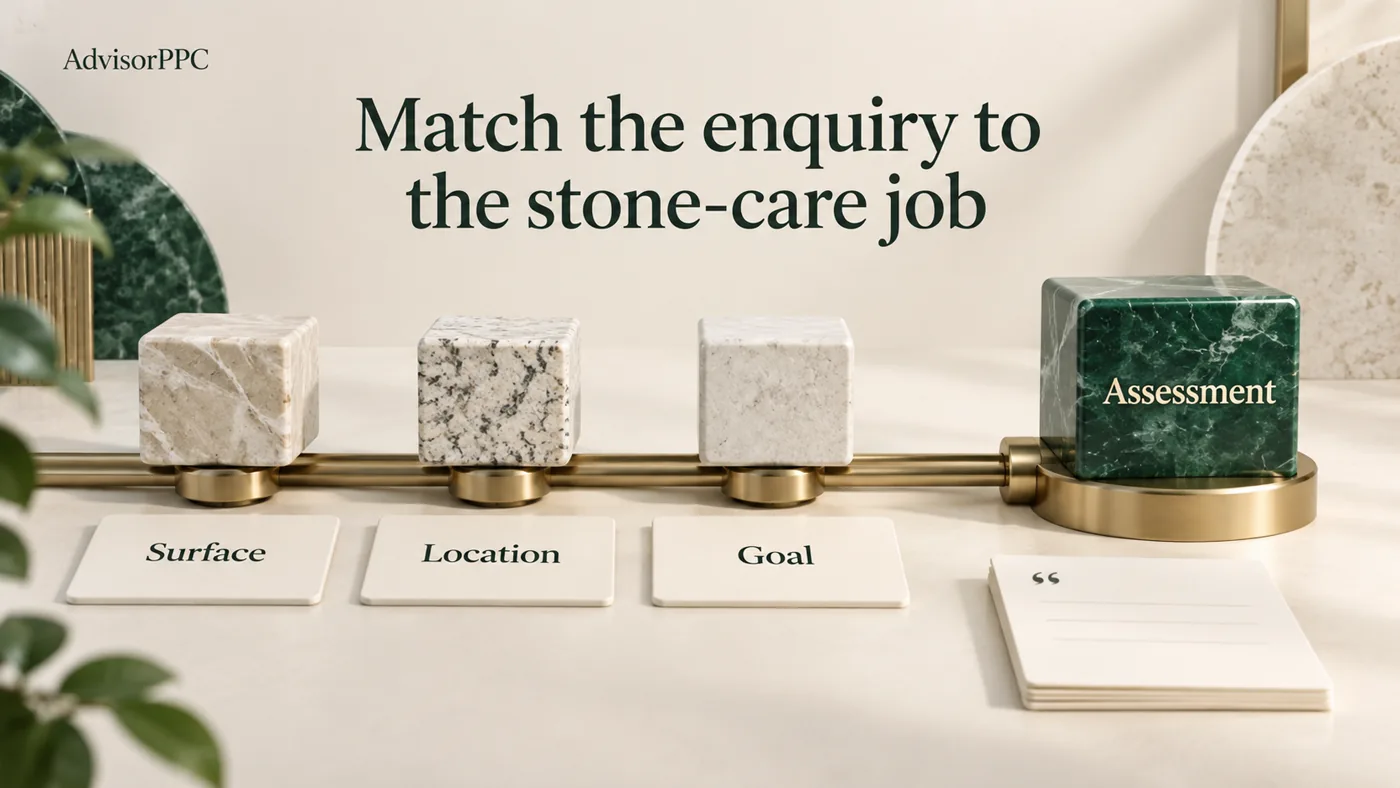
A stone-restoration inquiry is useful when the team can understand the requested work, determine whether it falls within the business's service area, and offer an appropriate assessment. That does not mean a marketing form should diagnose the surface or promise a treatment from a few photographs.
Define the information that changes the next operational step. Use it to route inquiries consistently and measure where suitable opportunities progress. The aim is a clearer service conversation and more defensible campaign evidence.
Describe the service boundary accurately
List the service categories the business actually provides and the area it serves. Identify work requiring an assessment before a quote, and conditions that the team cannot evaluate through a generic form.
Have the responsible technician approve the categories. A prospective customer may not know the material correctly, so the form should allow uncertainty. “Not sure” is often more useful than forcing an inaccurate answer.
Do not advertise a specialized restoration capability simply because a search term attracts inquiries. The marketing promise should reflect the business's verified knowledge and equipment.
Ask for practical routing information
Useful information may include the broad surface category, approximate area, general location, requested timing and an approved contact route. Explain why any photograph is requested and how it will be used.
Avoid asking the visitor to provide a definitive diagnosis or choose a treatment. Those are professional assessment questions. The next step can be a conversation or inspection rather than an automatic fixed quote.
Keep private addresses and photographs in the business's approved system. A public campaign report needs aggregate categories, not a customer's property details.
Use a hypothetical qualification example
Suppose the business receives 40 unique inquiries. In this hypothetical period, 28 concern work within its verified service scope and area. Twenty progress to assessment, twelve receive an accepted quote, and nine become completed paid jobs.
With $540 of advertising spend, cost per raw inquiry is $13.50. Cost per suitable inquiry is about $19.29, and advertising cost per completed job is $60.
These are different measurements. The example does not prove that advertising caused the nine jobs, and it excludes technician travel, assessment cost and other operating expenses.
If eight suitable inquiries remain open, record them separately. A weekly review should not count unfinished assessments as campaign failures.
Use reasons that guide a correction
Record a small approved reason list for inquiries that cannot progress: outside service area, unsupported work, duplicate, insufficient information awaiting response, or timing unavailable. Keep uncertain inquiries in an open category.
An increase in outside-area inquiries may suggest a geography or page-clarity review. An increase in unsupported work may indicate a mismatch between search terms, advertisement and service scope.
Google's About qualified leads and converted leads distinguishes qualified and converted outcomes. Consistent business reasons make those distinctions meaningful.
Our Search Intent in Google Ads: Buyers vs Researchers can help assess whether the query describes the service the business can actually provide.
Protect information throughout the journey
Review what photographs, forms, URLs and analytics events transmit. Do not put a customer's name, address or free-text project description into a marketing parameter just to connect reports.
Google's Best practices to avoid sending Personally Identifiable Information (PII) prohibits recognizable personal information in Analytics data. An operational inquiry record and a campaign reporting event should have separately defined purposes.
A visitor's repeated reading does not create a contact route or authorize follow-up. Contactability and permission need actual first-party evidence and an approved process.
Connect qualification with capacity
A suitable inquiry can still arrive when the crew cannot meet the requested timing. Track capacity-related delays separately from service mismatch.
Ask whether an assessment is available, who prepares the quote and how long the customer will wait for a response. Avoid using a fast-response advertisement when the team cannot support it.
Our Google Ads Message Match: From Query to Landing Page explains continuity. The page should describe the actual assessment and quotation process rather than presenting every request as a confirmed project.
Build a mobile-friendly intake and review sheet
For the visitor, use clear labels, a manageable number of fields and a truthful receipt message. The form should explain whether the request has merely been received or whether a next appointment is confirmed.
For the team, use a card per stage: suitable inquiry, assessment arranged, quote issued, quote accepted and job completed. Include open cases and the observation period.
A short review can ask where the process is losing suitable opportunities and whether the loss reflects campaign fit, capacity or follow-up. Those causes need different responses.
Change campaign signals only after validating the process
An advertising account cannot optimize toward a reliable later stage if the business labels it inconsistently. Validate the definitions and outcome records before proposing conversion changes.
Our Google Ads Primary vs Secondary Conversions: Decide What Bidding Should Value explains why selected goals matter. Any import, account edit or new integration requires its own verified implementation and approval.
Explore current AdvisorPPC plans and bring the qualification worksheet to a review. The useful decision connects real service capability with observable business stages, while preserving uncertainty and the customer's information.